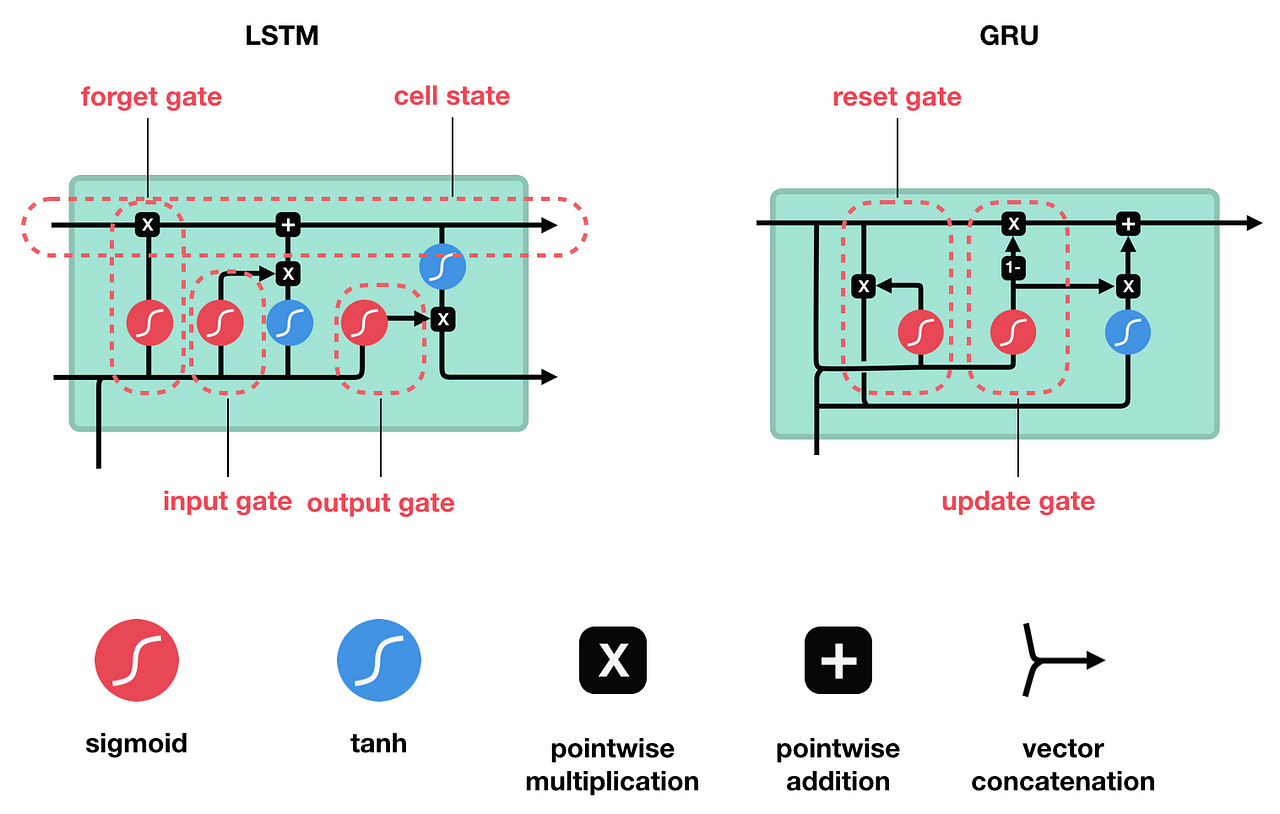
Which is better, GRU or LSTM?
RNN: Good for short-term dependencies. LSTM: Superior for long-term dependencies and handling complex sequences. GRU: Balances complexity and performance, often as effective as LSTMs but with faster training times.
How does LSTM solve the vanishing gradient problem?
This problem makes it difficult for RNNs to capture long-term dependencies in sequences. LSTM networks overcome this problem by using memory cells that can store information over a long period of time. An LSTM network consists of memory cells, input gates, forget gates and output gates.
Which gate does GRU lack compared to LSTM?
LSTM: LSTM typically has more parameters than GRU due to the additional gate (forget gate). This can make LSTM more powerful but also more prone to overfitting, especially on smaller datasets. GRU: GRU has fewer parameters since it lacks the forget gate.
Is LSTM dead?
LSTMs are not dead at all: current use-cases Here are a few examples of how LSTMs have been used in our daily lives (for years!):
The difference between the two is the number and specific type of gates that they have. The GRU has an update gate, which has a similar role to the role of the …
4. Training Speed: LSTM: LSTM has more parameters, which can result in slightly slower training times compared to GRU, especially on larger …
LSTM and GRU: Both are recurrent neural networks designed to address the limitations of traditional RNNs, particularly the issue of vanishing …